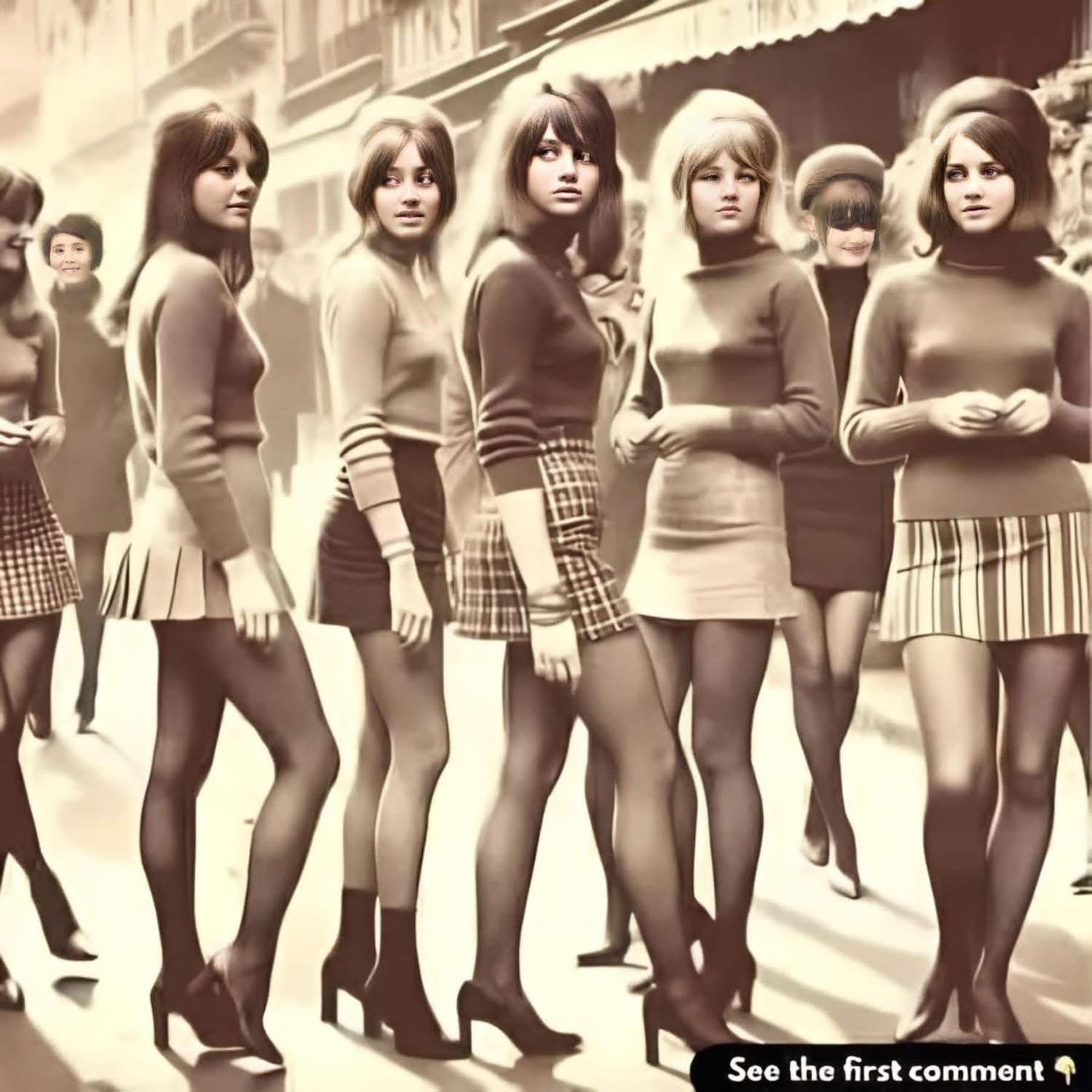
How Many People Can See What Is Special About This Photo? Look Closely and Brace Yourself for the Unexpected Twist
Introduction
At first glance, this photo looks completely ordinary.
There’s nothing immediately alarming or unusual about it. The people appear to be going about their day, the surroundings seem normal, and everything looks like a typical everyday scene.
But there’s one problem: something is hiding in plain sight.
Thousands of people have looked at similar photos online and confidently claimed they spotted the unusual detail within seconds. Others stared at the image for several minutes before finally noticing what everyone was talking about.
That is what makes this kind of visual puzzle so fascinating.
Your brain naturally focuses on the most obvious elements of a photograph. It looks for faces, objects, colors, and movement while automatically ignoring details it considers unimportant. That means something incredibly strange can sometimes sit right in front of you without being noticed.
So before you read any further, take another careful look at the photo.
Don’t rush.
Look at the background.
Look at the people.
Look at the spaces between objects.
And most importantly, don’t assume that the first thing you notice is the answer.
The Mystery Behind the Photo
The special detail isn’t necessarily located where you’d expect it to be.
That’s the trick.
When people see a mysterious photograph, they usually inspect the center first. They examine the main subject and assume the photographer deliberately placed the important clue there.
But visual puzzles often work differently.
The unexpected detail can be hiding at the edge of the image, behind another object, in a reflection, or somewhere your brain simply doesn’t expect to find it.
This creates an interesting psychological effect.
You can look directly at something without actually seeing it.
Why Is It So Difficult to Notice?
Human vision isn’t simply a camera recording everything equally.
Your brain constantly filters information.
Imagine walking through a crowded street. You may see dozens of people, cars, signs, buildings, trees, and objects. Yet your brain doesn’t consciously analyze every single detail.
Instead, it decides what deserves your attention.
This is extremely useful in everyday life, but it can make optical puzzles surprisingly difficult.
The photograph takes advantage of that natural tendency.
You think you’re examining everything, but your brain may already have decided which parts aren’t important.
The Unexpected Twist
Here’s where things become interesting.
The detail that makes this image special is not necessarily the obvious subject of the photograph.
That’s why so many viewers miss it.
When you look at a picture with the expectation that everything is normal, your brain interprets unusual details as ordinary objects.
You might notice the detail without realizing you’ve noticed it.
Only after someone points it out do you suddenly think:
“Wait… how did I not see that before?”
And once you see it, it’s almost impossible to look at the photograph the same way again.
Look Again
Before revealing the twist, try one more time.
Look at the foreground.
Then examine the middle of the picture.
After that, slowly scan the background from left to right.
Pay attention to:
- Unusual shapes
- Objects that seem out of place
- Reflections
- Shadows
- People’s positions
- Background details
- Objects partially hidden behind something else
- Anything that doesn’t quite make sense
Don’t just look at the obvious subject.
Look at everything around it.
Why People Love These Photos
There is something incredibly satisfying about solving a visual mystery.
At first, you’re confused.
Then you notice something unusual.
Finally, everything suddenly makes sense.
That moment of realization creates a powerful feeling of satisfaction.
It’s similar to solving a riddle or completing a difficult puzzle. Your brain enjoys discovering patterns and finding information that was previously hidden.
That’s why these photographs can become so popular on social media.
People don’t simply look at them.
They challenge their friends to find the answer.
A Fun Challenge for Your Friends
Instead of immediately revealing the answer, send the photo to someone you know.
Ask them:
“Can you spot what’s unusual?”
Don’t give them any hints.
Then watch how long it takes.
Some people will immediately announce that they’ve found it.
Others will confidently point to the wrong thing.
And occasionally, someone will stare at the picture for ages before suddenly realizing what they’ve missed.
That’s what makes these challenges so entertaining.
The “I Can’t Believe I Missed That” Effect
One of the funniest things about visual puzzles is that the answer often seems incredibly obvious after you know where to look.
Before the reveal, your brain says:
“There’s nothing unusual here.”
After the reveal, your brain says:
“How did I possibly miss that?”
This is known as the power of hindsight in perception.
Once your brain knows what it’s looking for, it becomes much easier to recognize the relevant detail.
What Makes the Photo Special?
The real magic isn’t necessarily that the hidden detail is incredibly complicated.
It’s that the photograph is designed—or happens—to make your attention go somewhere else.
The main subject distracts you.
The normal surroundings reassure you.
And your brain fills in the rest.
That combination makes the unexpected detail surprisingly difficult to notice.
The Best Way to Solve a Photo Mystery
If you want to become better at spotting hidden details, don’t stare randomly at the image.
Use a systematic approach.
Method 1: Scan From Left to Right
Start at one side of the photograph and slowly move toward the other side.
Don’t jump directly to the center.
Method 2: Examine the Background
The background is often overlooked because people naturally focus on the foreground.
Look behind every person and object.
Method 3: Look for Things That Don’t Belong
Ask yourself:
“Would this object normally be here?”
If the answer is no, investigate it.
Method 4: Check Reflections
Windows, mirrors, water, cars, and shiny surfaces can sometimes reveal details that aren’t immediately visible.
Method 5: Look at People’s Positions
Sometimes the clue isn’t an object at all.
It can be someone’s unusual posture, expression, clothing, or interaction with another person.
The History of Hidden-Image Puzzles
The idea of hiding pictures or objects inside larger images isn’t new.
For centuries, artists have incorporated hidden figures, symbols, faces, and optical illusions into paintings and illustrations.
In the nineteenth and twentieth centuries, hidden-image puzzles became popular in newspapers, children’s books, magazines, and puzzle collections.
Modern social media has transformed the concept.
Instead of appearing in a newspaper, a visual puzzle can now be shared with millions of people within hours.
One photograph can generate thousands of comments from people arguing about what they see.
The Psychology Behind the Challenge
Visual puzzles teach us something fascinating about perception.
Seeing isn’t simply about receiving information through your eyes.
Your brain interprets what your eyes receive.
Expectations, attention, experience, and context all influence what you consciously notice.
That’s why two people can look at exactly the same photograph and describe completely different things.
One person may immediately notice the unusual detail.
Another may completely overlook it.
Neither person is necessarily lying.
Their brains are simply prioritizing different information.
Benefits of Visual Puzzles
Although these challenges are mainly for entertainment, solving them can also be a fun mental exercise.
1. Observation
They encourage you to pay closer attention to small details.
2. Concentration
Finding a hidden object requires sustained attention.
3. Pattern Recognition
Your brain searches for relationships between shapes, objects, and positions.
4. Critical Thinking
You learn not to automatically accept your first interpretation.
5. Patience
Some puzzles cannot be solved instantly.
You have to slow down and inspect the image carefully.
6. Social Interaction
These challenges are perfect for sharing with friends and family.
The Biggest Mistake People Make
The biggest mistake is assuming the photograph is exactly what it appears to be.
When you look at an ordinary scene, your brain immediately creates a story about what’s happening.
You see a person.
You see a building.
You see a street.
You see a group of objects.
And then you stop questioning what you’re seeing.
But visual puzzles reward the opposite behavior.
Instead of asking:
“What am I looking at?”
Ask:
“What am I missing?”
That single question can completely change the way you examine the photograph.
The Final Reveal
And now comes the part that makes people go back to the beginning and look again.
The unexpected twist is hidden within the ordinary-looking scene itself.
The photograph isn’t necessarily special because of what is happening in the obvious foreground.
It’s special because your attention has been directed away from the detail that matters.
That is the entire trick.
Once the unusual element is pointed out, you’ll probably wonder how you didn’t notice it immediately.
And that’s exactly why these images are so addictive.
How Many People Can Actually Spot It?
That’s the real challenge.
Some viewers will find the detail immediately.
Others may need a hint.
And some will stare at the photograph repeatedly without noticing anything unusual.
So here’s your challenge:
Look at the photo one more time before reading the comments.
Don’t let anyone tell you the answer.
Give yourself a few minutes.
Zoom in if necessary.
Check every corner.
Then decide what you think the unexpected detail is.
Conclusion
Sometimes the most fascinating things aren’t hidden far away.
They’re right in front of us.
A seemingly ordinary photograph can become an incredible puzzle simply because one small detail changes the entire meaning of the scene.
That’s what makes these visual challenges so entertaining.
They remind us that our eyes don’t always tell the whole story.
So, how quickly did you spot the unexpected detail?
Did you see it immediately?
Did you need a second look?
Or did someone else have to point it out?
Look closely. Think carefully. And don’t trust your first impression.
Because sometimes the most surprising thing in a photograph is the thing you’ve been looking directly at the entire time.