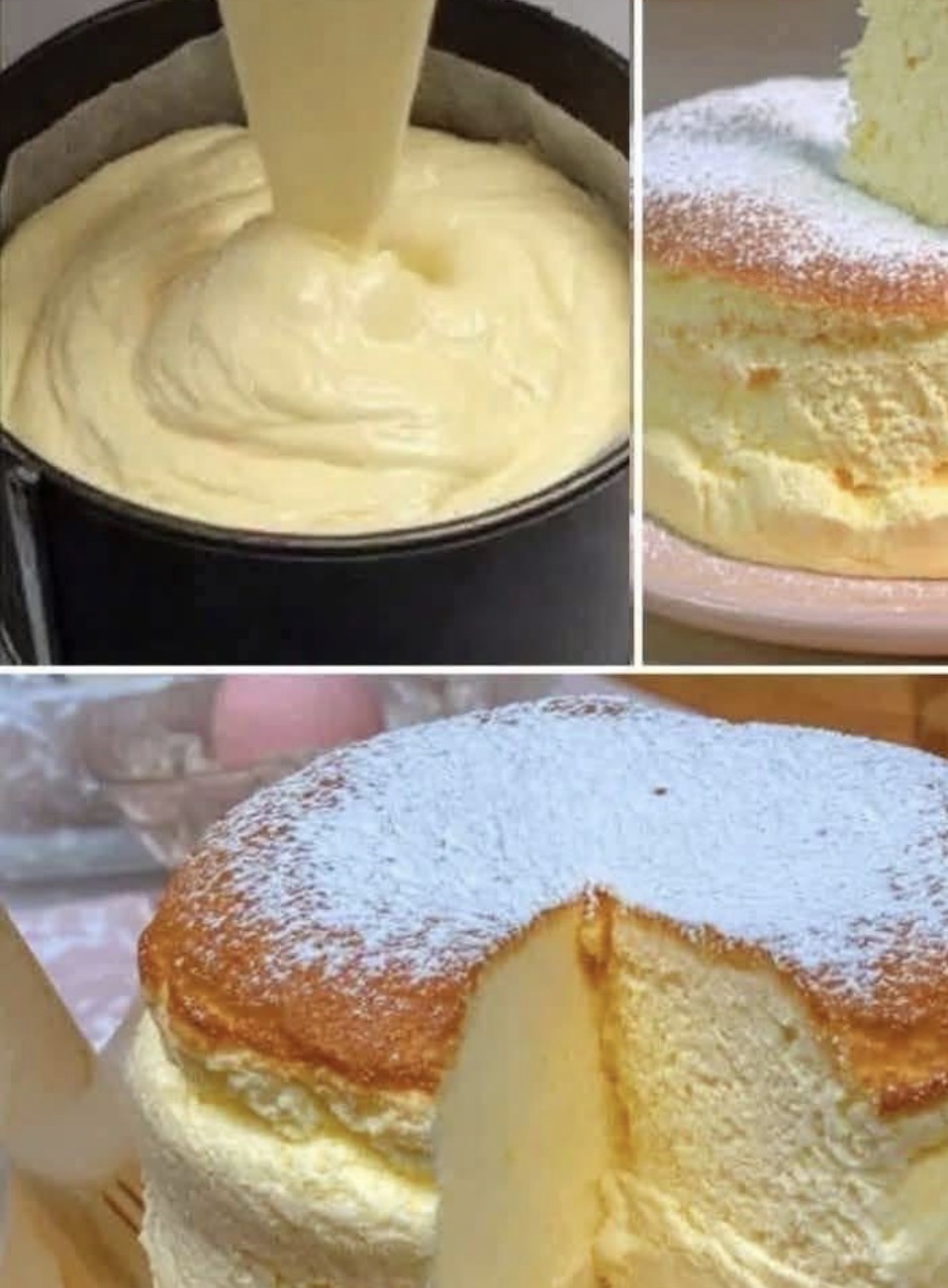
This gorgeous cake is famous for its cloud-like texture, delicate sweetness, creamy center, and beautifully golden top. From the picture, it looks like a Japanese-style cotton cheesecake, sometimes called Japanese soufflé cheesecake. It is lighter than traditional cheesecake and softer than a regular sponge cake—almost like eating a sweet, creamy cloud.
The secret is in the meringue, gentle folding, and slow baking. When done correctly, the cake should be tall, soft, moist, and slightly jiggly in the center.
🍰 Introduction
Japanese cotton cheesecake became popular because it combines the richness of cheesecake with the airy texture of a soufflé. Instead of a heavy cream-cheese filling, the batter is lightened with whipped egg whites.
The result is a cake with:
- 🤍 An incredibly soft and fluffy interior
- 🧀 A gentle cream-cheese flavor
- 🍋 A subtle fresh citrus taste
- 🥚 A delicate soufflé-like texture
- ✨ A golden, slightly caramelized top
- ❄️ A beautiful snowy finish with powdered sugar
It is wonderful served warm, at room temperature, or chilled.
🛒 Ingredients
For the cheesecake
- 250 g cream cheese, softened
- 50 g unsalted butter
- 100 ml whole milk
- 6 large eggs, separated
- 100 g granulated sugar
- 60 g cake flour
- 20 g cornstarch
- 1 teaspoon vanilla extract
- 1 tablespoon lemon juice
- 1 teaspoon finely grated lemon zest
- ¼ teaspoon salt
For the finishing
- Powdered sugar, for dusting
- Fresh berries, optional
- Strawberries, optional
- Whipped cream, optional
Equipment
- 20 cm round cake pan
- Baking paper
- Large mixing bowls
- Hand mixer or stand mixer
- Fine sieve
- Spatula
- Large roasting tray for the water bath
👩🍳 Preparation Method
Step 1: Prepare the pan
Preheat your oven to 160°C.
Line the bottom of a 20 cm round cake pan with baking paper.
If your pan has a removable bottom, wrap the outside very well with 2–3 layers of aluminum foil so that water cannot enter during the water bath.
For an especially tall cheesecake, you can line the sides with baking paper that rises a few centimeters above the rim.
Step 2: Prepare the cream-cheese mixture
Place the cream cheese, butter, and milk in a heatproof bowl.
Set the bowl over a pot containing a small amount of gently simmering water.
Stir slowly until everything melts together and becomes completely smooth.
Do not allow the mixture to boil.
Remove from the heat and allow it to cool slightly.
Step 3: Add the egg yolks
Add the egg yolks one at a time to the cream-cheese mixture.
Whisk gently after each addition.
Add:
- Vanilla
- Lemon juice
- Lemon zest
- Salt
Mix until smooth.
The mixture should look creamy and silky.
🌾 Step 4: Add the dry ingredients
Sift the cake flour and cornstarch together.
Add them gradually to the cream-cheese mixture.
Whisk gently until there are no visible lumps.
Do not overmix.
The batter should be smooth and relatively thin.
🥚 Step 5: Make the meringue
Place the egg whites in a completely clean, dry bowl.
Begin beating them at medium speed.
Once they become foamy, gradually add the sugar in 3 additions.
Continue beating until you obtain a soft-to-medium peak meringue.
This step is extremely important.
You do not want the egg whites to become extremely stiff and dry.
When you lift the whisk, the peak should stand but the tip should gently bend over.
That gives the cheesecake its beautiful soft texture.
🤍 Step 6: Combine the batter
Add approximately ⅓ of the whipped egg whites to the cream-cheese mixture.
Fold gently with a spatula.
Then add another third.
Fold again.
Finally, add the remaining egg whites.
Fold slowly from the bottom toward the top.
Important:
Do not vigorously stir the mixture.
The air trapped inside the meringue is what makes this cheesecake so fluffy.
♨️ Step 7: Prepare the water bath
Pour the batter into the prepared cake pan.
Gently tap the pan against the counter once or twice to remove large air bubbles.
Place the cake pan inside a larger roasting tray.
Pour hot water into the roasting tray until it reaches approximately 2–3 cm up the sides of the cake pan.
This water bath keeps the oven environment moist and helps the cheesecake bake gently.
🔥 Step 8: Bake slowly
Place everything carefully in the oven.
Bake at:
160°C for 20 minutes
Then reduce the temperature to:
140°C for approximately 40–50 minutes
The exact baking time depends on your oven.
The cake should become beautifully golden on top and feel slightly springy when gently touched.
If the top becomes too dark too quickly, loosely cover it with aluminum foil.
❄️ Step 9: Cool the cheesecake
Turn off the oven when the cake is finished.
Open the oven door slightly and leave the cheesecake inside for approximately 10–15 minutes.
This gradual cooling helps reduce the chance of dramatic collapsing.
Remove it from the oven and allow it to cool.
Once it is cool enough to handle, carefully remove it from the pan.
✨ Step 10: Finish the cake
Place the cheesecake on a serving plate.
Generously dust the top with powdered sugar.
For an elegant presentation, serve it with:
- Strawberries
- Blueberries
- Raspberries
- Whipped cream
- Strawberry sauce
- Raspberry sauce
- A little lemon zest
The beautiful snowy powdered-sugar finish shown in the picture makes it look especially elegant.
🍰 How to Get That Extremely Fluffy Texture
The most important part of this recipe isn’t simply the ingredients—it’s the technique.
1. Don’t overbeat the egg whites
Very stiff egg whites can make the cheesecake rise dramatically and then collapse.
A soft-to-medium meringue is ideal.
2. Fold gently
The batter should retain as much air as possible.
3. Use a water bath
This prevents the outside from becoming dry while the inside remains soft.
4. Don’t bake at an extremely high temperature
A very hot oven can cause:
- Cracking
- Rapid rising
- Shrinking
- A dry texture
5. Cool gradually
Sudden temperature changes can cause the cake to sink.
🌟 Variations
🍋 Lemon Cotton Cheesecake
Add an additional teaspoon of lemon zest for a brighter citrus flavor.
🍓 Strawberry Cotton Cheesecake
Serve chilled with fresh strawberries and strawberry sauce.
🍫 Chocolate Cotton Cheesecake
Replace approximately 15 g of the flour with unsweetened cocoa powder and add 50–70 g melted dark chocolate to the cream-cheese mixture.
🍵 Matcha Cotton Cheesecake
Add 1–2 tablespoons of high-quality matcha powder to the sifted dry ingredients.
🥥 Coconut Cotton Cheesecake
Replace part of the milk with coconut milk and sprinkle toasted coconut over the finished cake.
💡 Benefits of Homemade Cotton Cheesecake
While this is still a dessert and contains sugar, homemade cheesecake has some advantages over many packaged cakes.
🥚 Eggs
Eggs provide protein and help create the structure and airy texture of the cake.
🧀 Cream cheese
Cream cheese provides calcium, protein, and fat, while giving the cake its creamy flavor.
🍋 Lemon
Lemon adds freshness and helps balance the richness of the cream cheese.
🏠 Homemade ingredients
Making it yourself allows you to control:
- Sugar
- Portion size
- Ingredient quality
- Flavor
- Toppings
- Preservatives and additives
Of course, it remains a treat rather than a health food.
📖 A Little History
Japanese cotton cheesecake is associated with the development of Japanese baking techniques that blended Western-style desserts with Japanese preferences for lighter textures and gentler sweetness.
Unlike the dense New York-style cheesecake, Japanese cheesecake emphasizes airiness and softness.
The incorporation of whipped egg whites gives the dessert its characteristic soufflé-like structure.
Over time, it became especially popular in Japan and then spread internationally through bakeries, cooking videos, and social media.
Today, the cake is loved around the world for its distinctive jiggly, fluffy texture.
❤️ Why Cheesecake Lovers Love It
Traditional cheesecake lovers may enjoy this version because it still has that delicious cream-cheese flavor—but with a completely different texture.
It is:
Creamy + fluffy + light + slightly sweet + buttery + incredibly soft.
One bite gives you the sensation of cheesecake, sponge cake, and soufflé all at once.
🍽️ Serving Suggestions
For the best presentation, cut the cake using a sharp knife.
For cleaner slices, warm the knife under hot water, dry it completely, and then cut.
Wipe the knife between slices.
Serve with:
Simple
Powdered sugar + fresh strawberries.
Elegant
Whipped cream + berries + strawberry sauce.
Café style
A slice of cheesecake + coffee or tea.
Dessert style
Vanilla ice cream + berry sauce.
Japanese-inspired
Matcha powder + strawberries + lightly sweetened whipped cream.
🧊 Storage
Keep the cheesecake refrigerated in an airtight container.
It is best enjoyed within approximately 2–3 days.
Interestingly, many people enjoy it even more after refrigeration because the texture becomes slightly denser and creamier while remaining soft.
Before serving chilled cheesecake, allow it to sit at room temperature for around 10–15 minutes for the best texture.
🔥 Troubleshooting
Why did my cheesecake collapse?
A small amount of shrinking is normal.
However, major collapse can happen because of:
- Underbaking
- Overbeating the egg whites
- Overmixing after adding the meringue
- Sudden temperature changes
- Opening the oven too frequently
Why did it crack?
The oven may have been too hot, or the cake may have been too close to the top heating element.
Why is the bottom wet?
The water bath may have leaked into the pan, or the cheesecake may need additional baking time.
Why isn’t it fluffy?
The most common cause is losing too much air while folding the egg whites into the batter.
⭐ Pro Tips for a Bakery-Style Result
Tip 1: Bring the cream cheese and eggs close to room temperature before starting.
Tip 2: Sift the flour and cornstarch.
Tip 3: Use fresh eggs for the best meringue.
Tip 4: Make sure there is absolutely no egg yolk in the egg whites.
Tip 5: Keep your mixing bowl completely clean and dry.
Tip 6: Fold the meringue gently.
Tip 7: Don’t constantly open the oven door.
Tip 8: Bake with a water bath.
Tip 9: Let the cake cool gradually.
Tip 10: Dust with powdered sugar just before serving.
🥛 The Perfect Texture
When you cut into the finished cake, you should see a delicate, fine crumb.
The exterior should be golden.
The inside should be pale, soft, moist, and airy.
When you gently press the cake, it should have a soft spring-back rather than feeling dense.
That is the signature of a successful Japanese cotton cheesecake.
🎂 Final Conclusion
This Ultra-Fluffy Japanese Cotton Cheesecake is the perfect recipe when you want something impressive without making a heavy, dense cheesecake.
Its combination of cream cheese, eggs, butter, milk, and a carefully whipped meringue creates a dessert that is incredibly delicate and satisfying.
The golden top, snowy powdered sugar, creamy center, and cloud-like texture make it perfect for birthdays, afternoon tea, family gatherings, celebrations, or simply enjoying with a cup of coffee.
And the best part?
When you cut that first slice and see how incredibly soft and fluffy the inside is, you’ll understand exactly why this cake has so many lovers. 🤍🍰